
It’s the sort of thing that comes up mid-project all the time. A client starts running Facebook ads, or switches booking systems, or adds a members’ area, and asks: “does that change anything with our privacy policy?” Fair question, and one that’s hard to answer if you don’t actually know what’s sitting behind the policy on your site.
We’ve written before about whether you need a Privacy Policy, what a Cookie Policy actually covers, and where the law’s heading. What we haven’t explained is what actually happens when you say yes to getting this set up through us, and what it’s like day to day after that.
How Termageddon actually gets set up
We manage this for clients through a platform called Termageddon. The account belongs to the client, but we can access it too, and it’s built around one thing: a genuinely thorough questionnaire about what your website and organisation actually do with people’s information.
Here’s how that plays out in practice. I set up the account and go through your website myself first, filling in everything I can see: what forms you’re collecting through, what analytics or ad tracking is running, whether there’s a booking system, a CRM, a members’ area, anything that touches a visitor’s data. Then we jump on a quick call, phone, Zoom, Teams, whatever’s easiest, to close the gaps. Things that aren’t visible from the outside: which CRM you’re actually using, whether you’re running Meta ads behind the scenes, how you handle a request from someone wanting their data deleted.
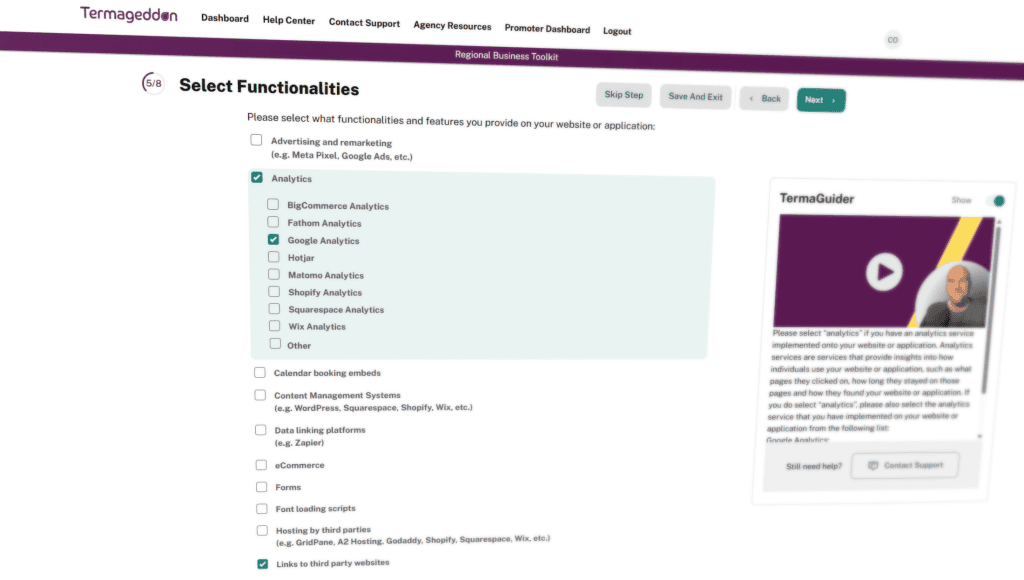
Once that’s done, you get a chance to read back through the questionnaire yourself, not to redo the work, just to confirm you’re comfortable with what’s being said yes and no to. It’s usually quick, because by that point most of the thinking’s already been done.
From there, Termageddon builds your Privacy Policy, Website Terms and Cookie Policy directly from those answers, and we connect that to the relevant pages of your site. The questionnaire answers drive the policy, built to match what you told them, not a generic template with your business name dropped in.
What happens when something changes
This is the part that actually matters once the initial setup’s done, and there are two separate ways your documents stay current.
The first is your website changing. Say you start running Facebook ads midway through a project I’m doing for you. You mention it, I go into your Termageddon account, answer the new questions about ad tracking, and the relevant section of your Privacy Policy updates straight away, the pixel, what data might reach Meta, all of it. You don’t touch anything. The only job on your end is telling us when something’s changed, not remembering to reread a legal document.
The second is the law changing underneath everyone. Termageddon monitors the Australian legislation federally and at the state level. When something shifts, they draft the actual wording change themselves and email both of us: here’s what’s changed, here’s the update we’ve drafted, click here to review and approve it. Once it’s approved, it goes live on your site immediately. Nobody’s relying on you or me noticing a change in the Commonwealth Gazette.
Why committee approval doesn’t fit anymore
I volunteer on a handful of committees myself, and one of them has spent the last eighteen months getting its Privacy Policy through committee approval. It deals with information about families, so a slow, careful process for that document makes sense.
What doesn’t make sense is applying the same process to a website that changes far more often than any committee meets. Most of the organisations I work with touch something that affects their Privacy Policy a handful of times a year: deciding to run Facebook ads for a season, switching analytics platforms, starting a newsletter and capturing sign-ups for it. None of those need a rewrite.
Usually it’s one line.
The traditional approval process isn’t wrong for the original document. It’s built for something that changes once every few years. A website doesn’t work on that timeline anymore, and a Privacy Policy that’s supposed to describe it can’t either.
What it costs, and what you’re actually paying for
It’s $180 a year, covering the account, the initial setup work, and every update after, whether that’s driven by your website changing or the law changing. A free template covers none of the second part and usually skips the thoroughness of the first, because nobody sits down and works through what your specific site is actually doing.
It isn’t legal advice, and we’re upfront about that with every client. What it is: a properly configured set of documents that keeps matching your website, without either of us having to remember to check.
The bit that’s easy to miss
The whole point of the setup, the questionnaire, the call, the read-through, is that it happens once, properly, rather than being something you’re expected to maintain yourself afterwards. It’s a bit like having a bookkeeper who reads every tax ruling that comes out and only calls you when something in your actual business is affected by it, rather than handing you the ruling and leaving you to work out if it applies.
Most clients never log into their Termageddon account again after that first read-through. That’s the intended outcome, not a gap in the service.
See what’s included, or get yours set up →
Want to know what the questionnaire would actually ask about your website? Flick me an email →
This article provides general information about websites and privacy considerations. It isn’t legal advice. Whether your organisation’s Privacy Policy, Website Terms or Cookie Policy meet its obligations depends on its individual circumstances and activities. If you’re unsure of your legal obligations, speak to an appropriately qualified legal professional.